

João Marcos Moreira: The Art of Reimagining Portuguese Natural Stone
May 2025
João Marcos Moreira: The Art of Reimagining Portuguese Natural Stone
We delve into the creative universe of designer João Marcos Moreira, who, in collaboration with ASSIMAGRA and the Olivah studio, is reimagining the way we engage with Portuguese natural stone. Within the scope of the Broot project, the designer reveals how marble and cork—emblematic materials of our land—come together in harmony to create pieces that reflect our history, culture, and territory. His collaboration with the Galrão Group underscores the value of artisanal craftsmanship, authenticity, and the preservation of traditions while embracing innovation. With a sustainable mindset and a forward-looking perspective, the designer shares his journey of reclaiming memories and rethinking design—creating not just objects, but pieces that embody the essence of our past and identity.

Let’s start with the Broot project. What was it like for you to be part of this initiative by Assimagra? What motivated you to take on this challenge?
I was truly honored to receive the invitation from Assimagra and Olivah to join the first Broot collection. I believe that every partnership begins like a seed, and this one placed us before a rare opportunity: to rethink Portuguese natural stone in dialogue with other materials rooted in different regions. In a deeply elemental way, the materials called us back to our origins, challenging us to build bridges between masters and industries once isolated in their crafts. Broot not only promotes the value of national raw materials, but also tells the story of Portugal—through its resources and ancestral techniques. Working with marble and cork was not merely an aesthetic choice, but a reunion with a forgotten language—one I wished to rediscover, translate, and reinterpret.
Broot proposes a new reading of Portuguese natural stone. In your view, what is the role of stone—and marble in particular—in contemporary product design?
Stone—and marble especially—is petrified memory. It carries with it time, silence, movement, and resilience. In an increasingly volatile and fast-paced world, marble invites us to pause and contemplate. It is a material that endures and teaches us to respect the process. In contemporary design, its presence stands in contrast to the ephemeral. Its weight is symbolic, and its almost ethereal patterns remind us that we are part of something greater, older, and more enduring than ourselves. It creates an alliance that connects past, present, and future—one in which we can find reflection and identity.
In your work within the project, you combine marble with cork. How did this combination of materials come about? What kind of dialogue were you looking to create between them?
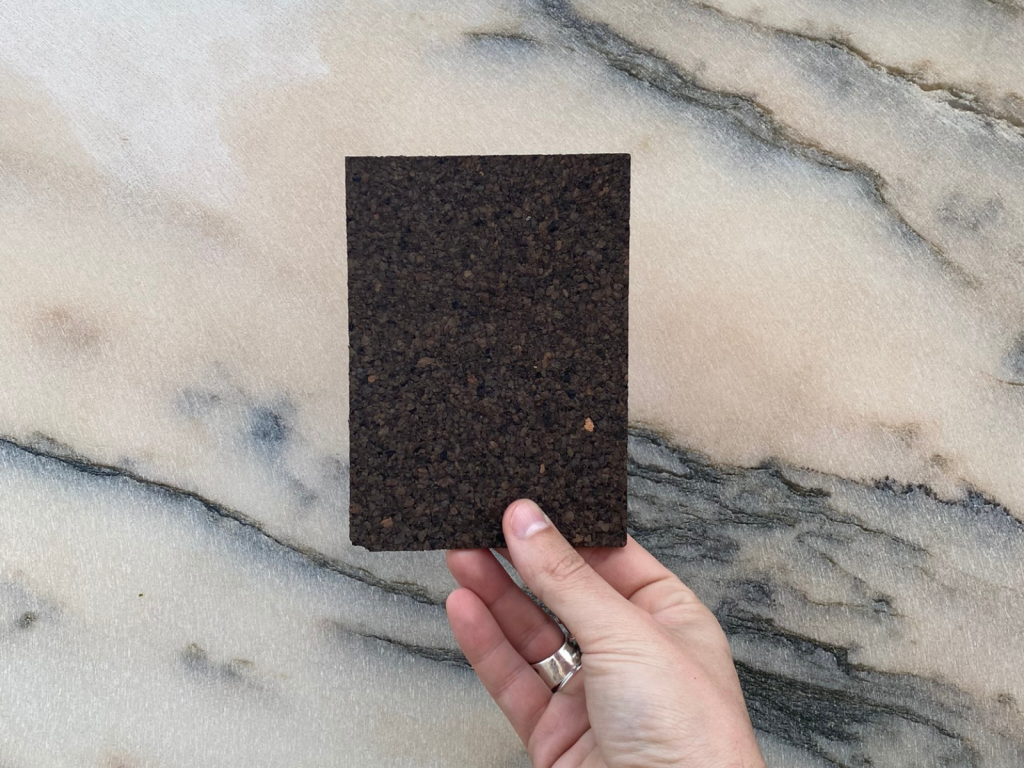
The combination of marble and cork did not arise from contrast, but from affinity—both materials coexist in the Alentejo landscape. One is extracted from the depths of the earth, the other harvested from the living surface of trees. Marble is cold, dense, and solemn. Cork is warm, light, and fertile. Together, they evoke a tension that embraces both sky and subsoil. My intention was to make them speak as elements of a shared myth—raw material as a metaphor for the human condition and its spirituality. This collection stems from the observation of the historical heritage and native flora of southwestern Portugal. It is a manifesto of the harmonious symbiosis between what the Alentejo once was and what it continues to be today—where the grandeur of megalithic monuments blends with the grace of cork oak trees. A landscape petrified for over 7,000 years, symbolizing the region’s timeless essence.
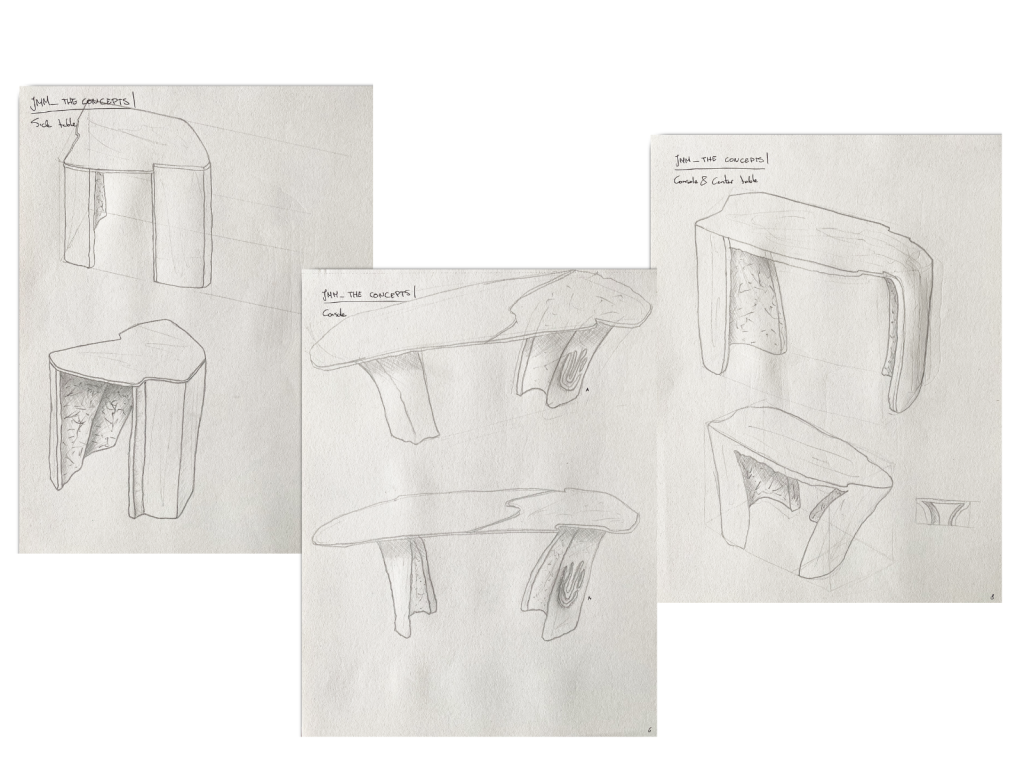
Tell us about the creative process behind your pieces for Broot. How did you conceive the volumes, textures, and functions? Was there any piece that particularly stood out to you?
The process felt like an archaeological rebirth. Each form emerged from the symbiosis of opposing elements that coexist within the landscape. Monumental silhouettes merge with the grace of cork oaks and the act of cork harvesting, as though we were excavating not only the stone, but also time and our own history. Throughout the research, I uncovered fascinating insights about the region. Portugal—particularly the Alentejo—is the second most densely concentrated region of megalithic monuments. These spaces once served ritualistic, ceremonial, or funerary purposes, but were also used as geographic and astronomical markers. In dolmens, the walls were painted with ochre and the deceased were placed in a fetal position inside the central chamber, which symbolized the womb—so that they could be reborn. These elements are reflected in the pieces by lining the interior of the marble structures with cork.
One particularly striking reference comes from Professor José Armando Saraiva, who believed that the menhirs—phallic-shaped structures—were used to fertilize the earth’s womb, as part of a cult of land fertility. This makes evident the symbolic relationship between fertility and finitude; life and death; light and shadow; the organic and the static. The landscape in which these prehistoric peoples once lived is the same we still see today—serving as a bridge between the Alentejo’s past and present. In this way, I associated the organic forms and curved silhouettes of the pieces with the rings of trees and the motion of cork harvesting. These pieces were conceived as lost fragments that have now been rediscovered. The intention was to create not just objects, but vestiges.
Did your connection with the Galrão Group emerge during the creative process and material selection? How was that relationship? What are your impressions from collaborating with the company?
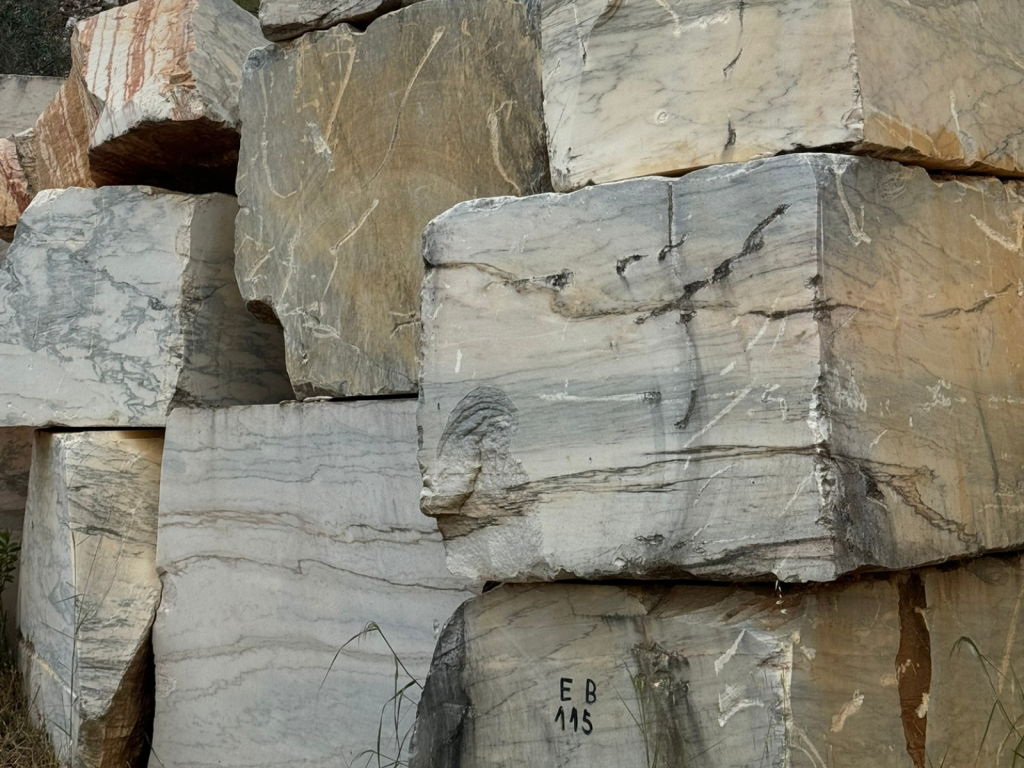
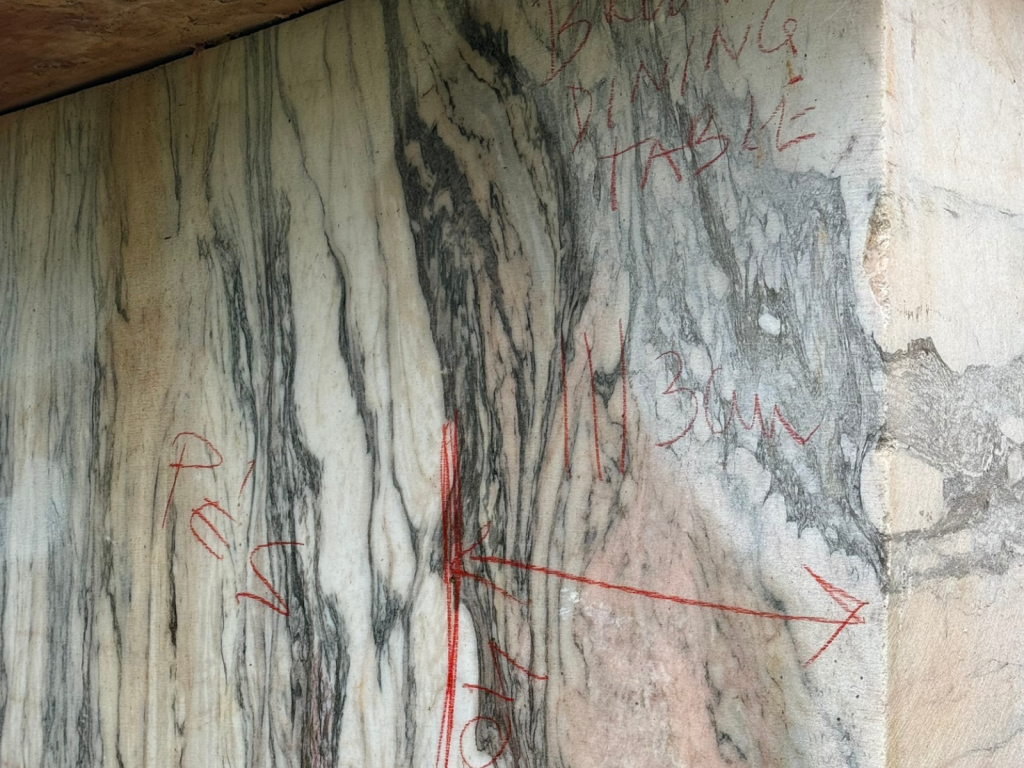
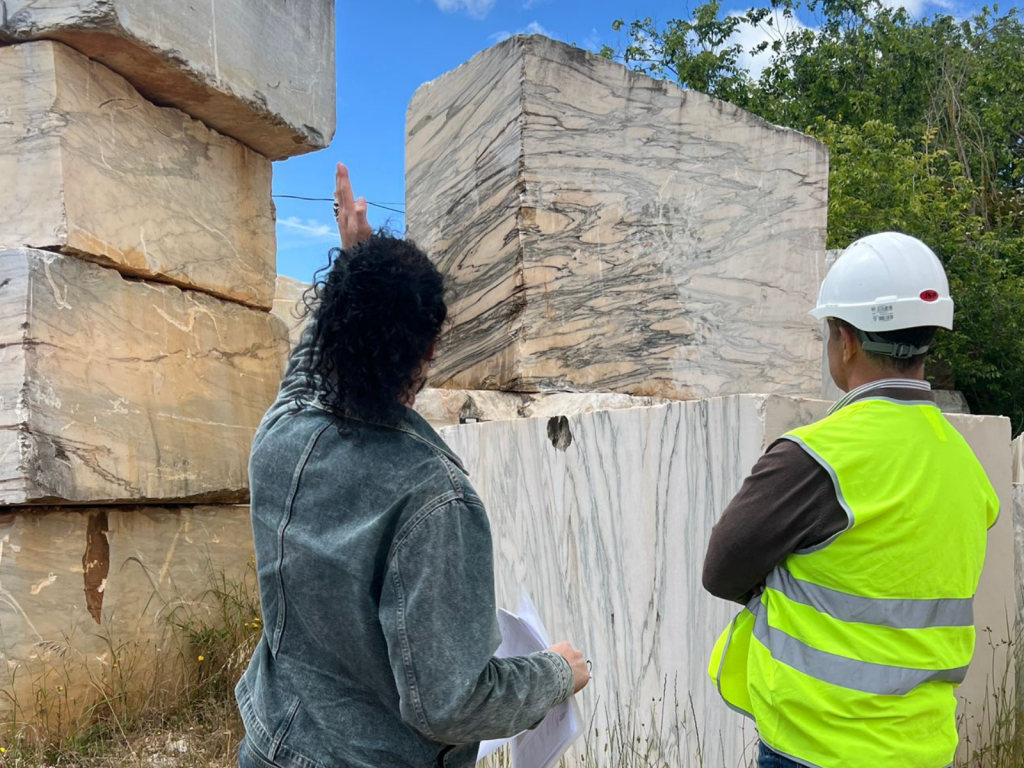
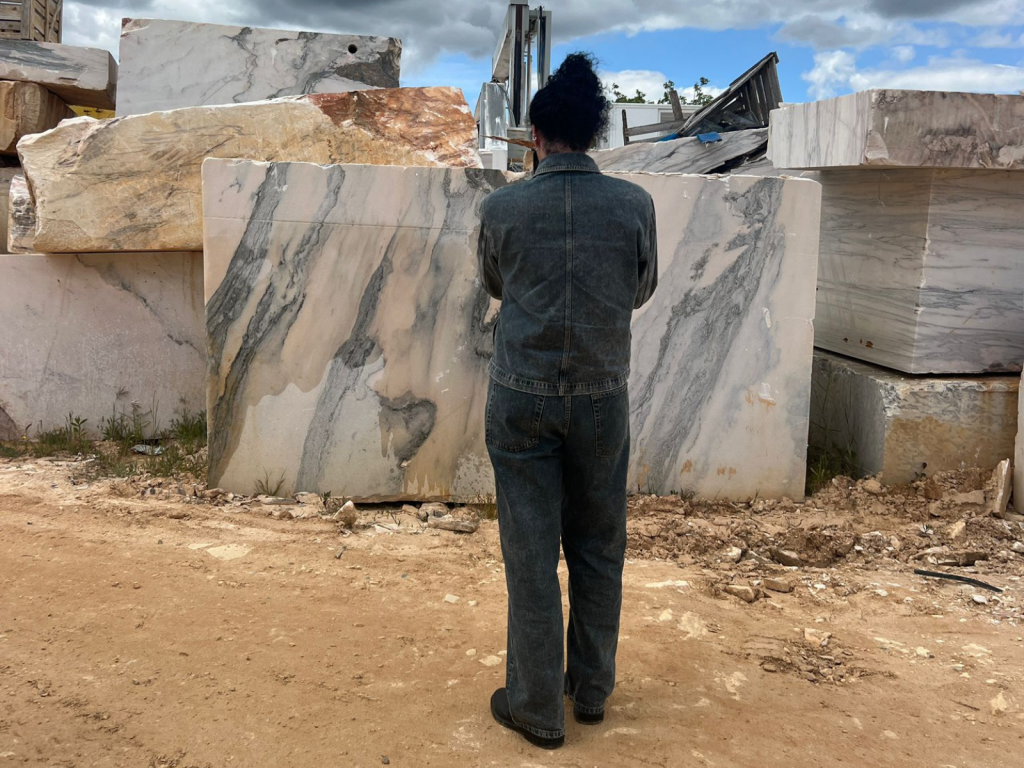
Galrão emerged as a true guardian of the material—someone who not only knows it, but honors and celebrates it. The relationship was established naturally and with mutual respect throughout the entire process. During the visits to the quarries and their collection, I was welcomed with a sense of attentive and curious listening. I felt that each stone was introduced with the enthusiasm of someone genuinely fascinated by it. The selection of each block was almost ritualistic: each cut, vein, pattern, and imperfection carried a story we wanted to tell. I take with me a deep admiration for their commitment to craftsmanship, authenticity, precision, and professionalism.
And what was it like working with Galrão marble? What stands out to you in terms of quality, material response, or the technical support from the team?
Galrão carries a legacy, and their stone is both a witness and heir to that heritage. Each block bears density and depth in its colors and patterns, making every piece unique and unrepeatable. Carefully selected, the stones flourish when treated with respect—and that is exactly what the Galrão team masters. Their technical support was essential and acted as a foundation for the creative process, forming the ideal partnership for the development of the collection. Together, we understood that this wasn’t just about execution—it was about preserving the intention, the emotion, and the gesture behind each form through the stone.
Looking to the future—how do you envision the evolution of design with natural stone? What opportunities do you see in this connection between tradition and innovation?
Art and design are the materialization of our culture and emotions, preserving them through different objects. Throughout history, humanity has demonstrated its contemplative connection to artifacts. I believe in a future where these disciplines bring us closer to our essence, and natural stone plays a vital role in that path—it invites us to create with awareness, memory, and time. Innovation doesn’t lie in denying tradition, but in listening to it differently and rewriting it. Rather than seeking solutions in mass industries, the key lies in optimizing raw materials. With a sustainable mindset, mindful of waste, and by connecting small and medium producers, we gain a new way of entering the market—one that, in partnership with the energy of designers and studios, gives these materials a new voice. I see stone as an open archive where each generation can write without erasing what has already been said. That will be our challenge: to continue sculpting the future without renouncing the past.
Will we see new pieces soon? If so, can you share anything about them or what you’re currently developing?
Working closely with the industry has revealed to me the plasticity of what stone is capable of. At the moment, I’m developing a new collection that continues the stories that inspire me and that carry within them this primitive language. It’s a series of sculptural pieces in limited editions, in which marble remains the protagonist. Objects that evoke the ritualistic and the ancestral, dwelling on the threshold between the useful and the symbolic. The collection will reinforce this prehistoric and ceremonial aesthetic, rooted in the essence of humankind and our bond with the earth—but with our gaze turned toward the cosmos.
Finally, what would you like people to feel when they see or touch your pieces? Is there a message or emotion you hoped to convey?
My goal is that, beyond representing our national raw materials, the pieces embody our stories—and that through the silhouettes I create, they reflect the region and all it produces. More than creating products, we are telling our story. I hope people feel a pause. A silence. That when they touch the pieces, they also touch something unseen, but deeply felt: time, memory, the sacred. I want my pieces to awaken a sense of wonder and belonging to something greater, vaster, and older. If they can spark that inner journey—then they’ve fulfilled their purpose.